Periodic Phrasing, aka Middle Ground Rhythms
Thanks to JM for a quesiton about periodic phrasing in my Piano Trio, "25 Decades". It's a subject that appeals to me because so few talke about it.
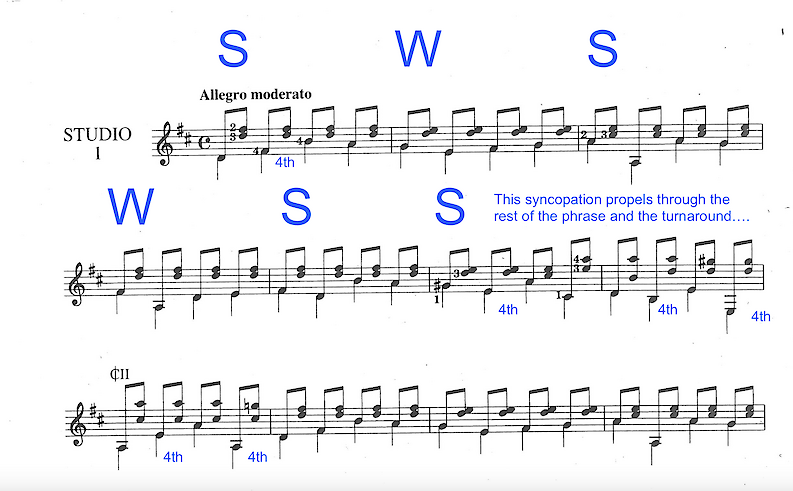
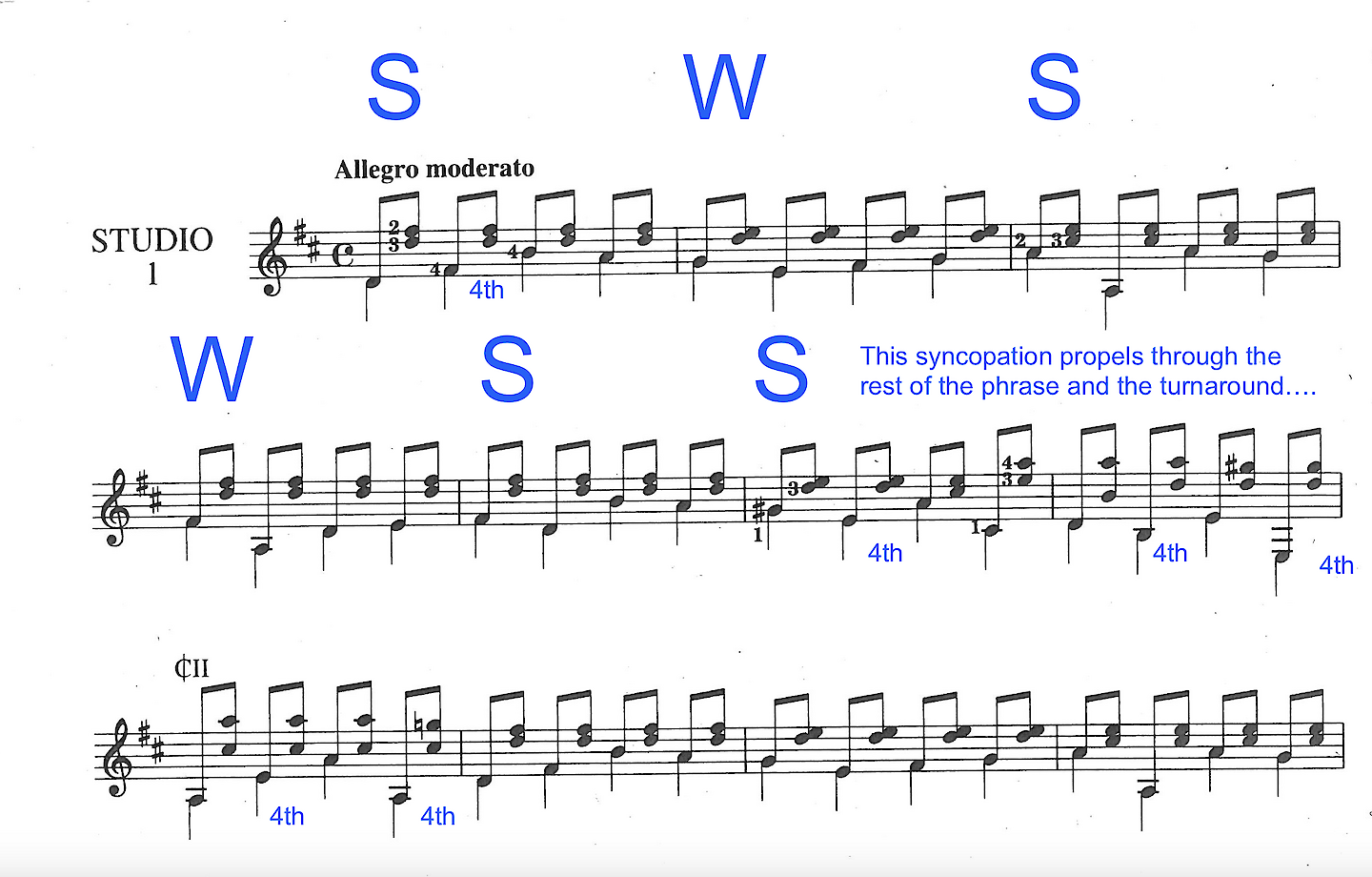
This is a guitar study by Fernando Sor. Some students hate Sor's music, finding it too simple and cloying. This peice has a real sophistication -- the syncpation, and also the play of 4ths is a stealthy Andalusian abstraction -- a real song without words.
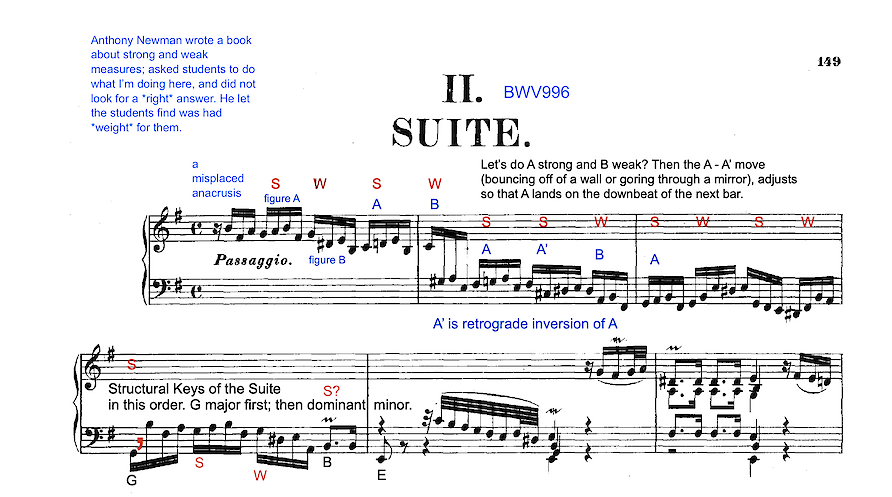
From henceforth in BWV996 G major appears before the dominant minor. The dominant minor ends the A section in all but the Bouree. Is he reminding us that moving the cadence on G to the final bar of the A section involves a syncopation on the scale of measure, something like we find here on in the scale of beats?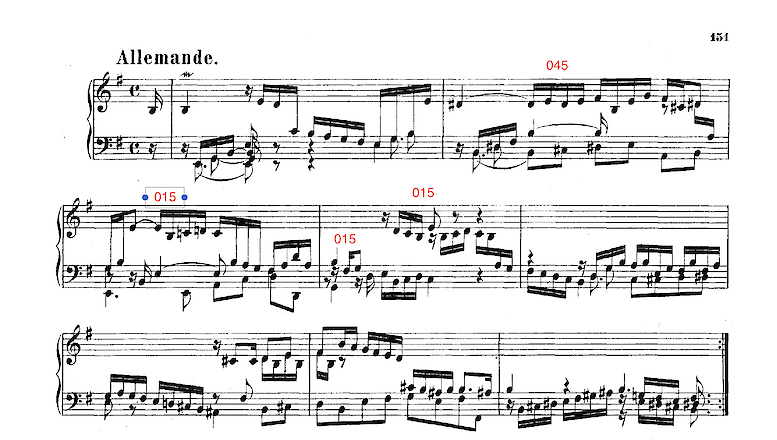
I've always been struck by the move in the Allemand, briefly, to the *key* of 015. Brahms cello sonata plays with the same pitches, making the major 7th quality by adding the C above the tonic triad.
Think also of Brahms op. 88 is, in a way, in the "key" of 015, from the very first measure (C - - F | E - F - | G A Bb C A G | etc.). I call that the Schoenberg op. 9 thing--each theme is not a key, but an interval cycle, as Milton Babbitt pointed out at his 90th birthday concert. I'm interested in all instances of B C D B C, first in m. 3 then, in m. 4 -- D C B E B C D C B......
The Bouree tells us that getting the G to appear in the final bar involves passing through a mirror. 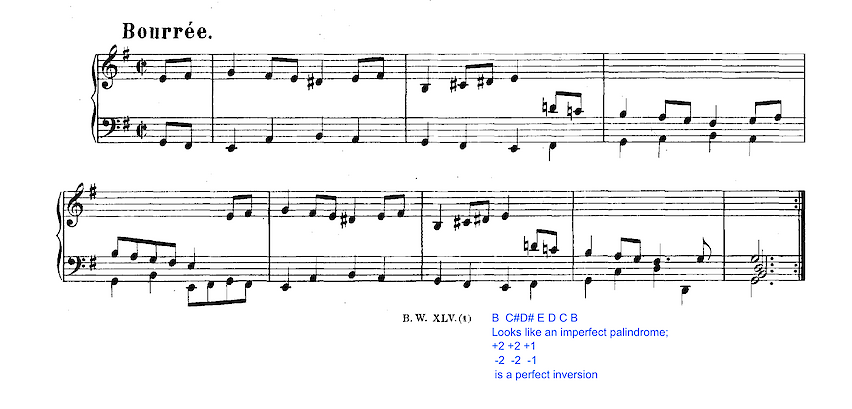 There's much more to ponder in the Courante and Saraband. Sarabande -- the big moves happen on beat 2, but beat 2 is smeared over where the doings are more local in scope.
Living with such things for years and years, I can say honestly that the periodic phrasing and phrase rhythms in my piano trio come from right out of these examples. There's also a lute solo by Joan Ambrosio Dalza that I want to add here.
Piano Trio "25 Decades"
Piano Trio "25 Decades" -- in short, at bar 11 the piano syncopates into Bb and at bar 20 it unsyncopates back into E.
(And I now see the decades, and I like that.)
And the single bars between 4 & 8 bar phrases are very weird.
I wait to see what the Horszowski Trio does and learn what it's all about. What I know is just the beginning.
The +1 bar figure has its big moment in m. 177 into 178 -- A | F#, etc......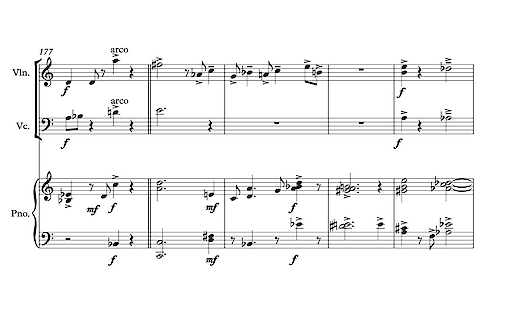
I thought of bar 1 as a pickup bar.
4 bars + 1 bar + 4 bars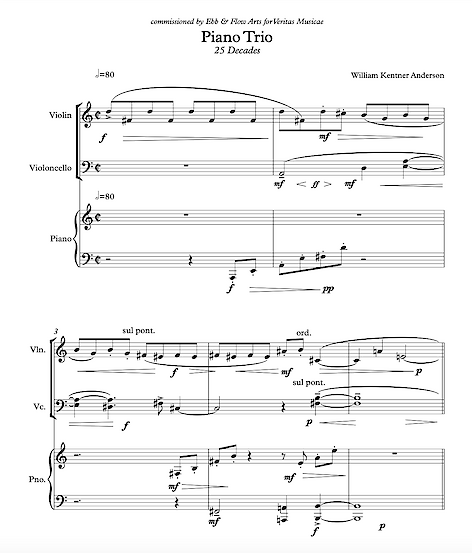
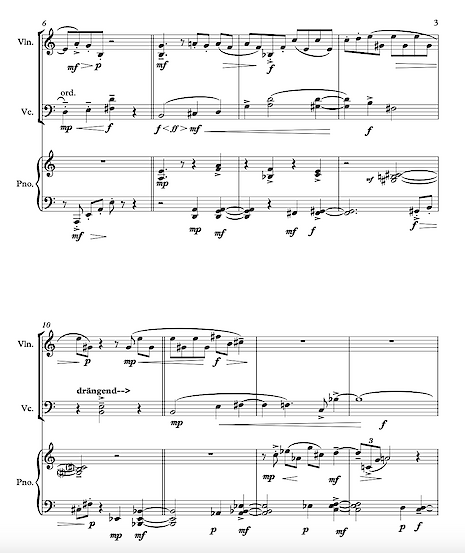
is followed in bar 11 by
8 bars + 1 bar + 8 bars
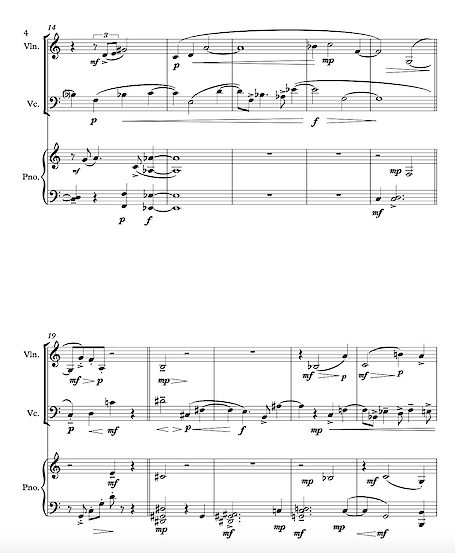
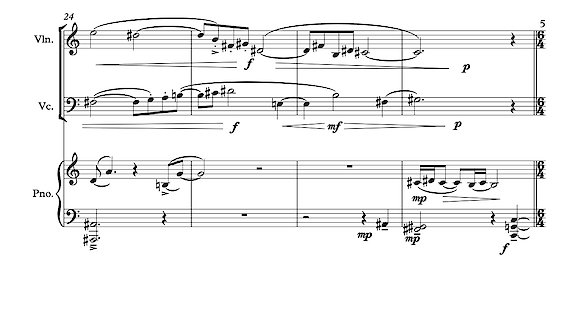
The piano syncopates into Bb (bars 11 through 18) and unsyncopates back into E major.
All the civic unrest (see the other essay on this site) in this opening and throughout the exposition, all the way to bar 228 where things fall apart, comes from building the elements Carter's all trichord hexachord. The power and unsettling quality of that hexachord is in that its subsets repel each other.
in cello repels and the all-trichord hexachord is built around two 5th a tritone apart.
Ab Eb B E F# D
Eb Ab E B C# A
E A Ab Eb F Db
A E Eb Ab Bb C
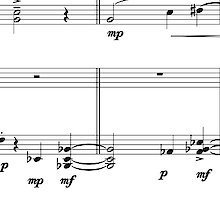
bar 10..............bar 11
William Anderson
I compose, play plucked instruments, run ensembles, produce concerts, and advocate for new music, I soaked up contemporary American music for 30 years, working directly with composers from all over the map. In the last 20 years I began composing works that draw on that experience, with a particular concern for finding a coherent way to make reconciling musics that were sealed off from one another. How to make embarrassingly simple and charming music work with the most complex musical modalities? Tipping in this direction has made me aware of the dangers of grasping too firmly onto any one notion.
I've come to Macherey's vision that our shadow (what we're *not*) is radiantly present in our work. So it's perfectly reasonable to *love everything*. We're imbricated. --
**The true necessity of the text manifests itself in the fact that not a word of it can be changed and nothing can be added, even though it appears at each moment as though a new topic could be chosen, an alternative narrative selected. But it is precisely this ceaseless shadowy presence of other possible phrases which could be pronounced, this ineradicable sense that things could have been other than they are, which enforces the constraining necessity of the text we actually have before us.**--Macherey