Napoleon, Montgelas and The Secularization of Aldersbach
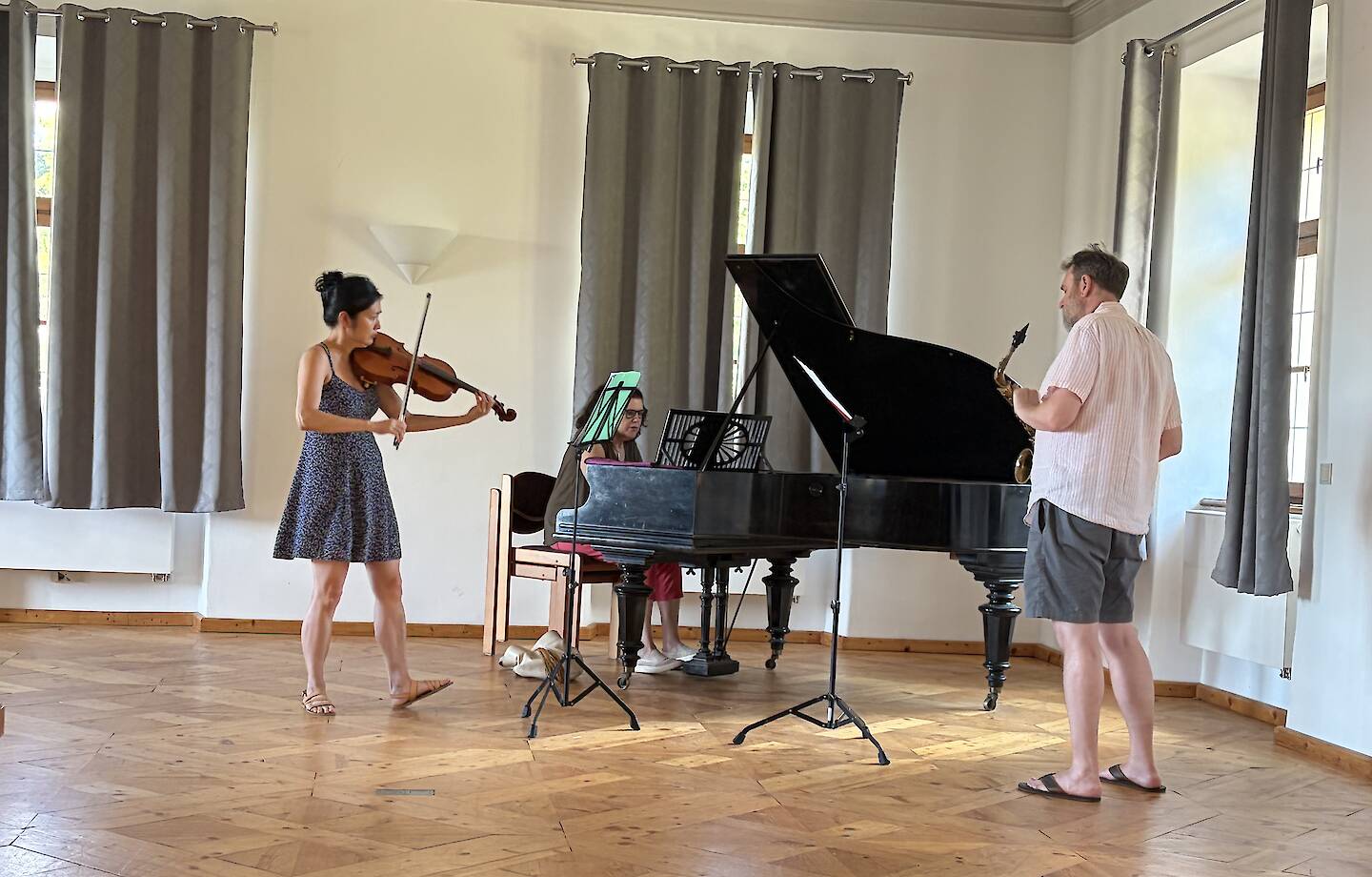
Chiu Chen, Joan & Tim @ Summer Music Aldersbach 2026
////////
Maximilian Josef von Montgelas (1759–1838) — the man who, more than anyone, invented modern Bavaria, and the actual dissolver of Aldersbach.
He's a wonderfully paradoxical figure. Born in Munich to a Savoyard noble family (the name is French, pronounced roughly mon-zhe-LAH; his father was a general in Bavarian service), educated by Jesuits, then at Strasbourg — and he emerged a thoroughgoing Enlightenment rationalist. As a young official he joined the Illuminati, Adam Weishaupt's Bavarian secret society of enlightened reformers, and when the order was banned in the 1780s he prudently fled Bavarian service, ending up as adviser to Duke Max Joseph of Zweibrücken. That exile made his career: when Max Joseph unexpectedly inherited the Bavarian electorate in 1799, he brought Montgelas with him as chief minister — effectively prime minister, foreign minister, interior minister, and finance minister rolled into one for the next eighteen years.
What he did with that power amounts to a revolution from above:
- The Napoleonic gamble. He allied Bavaria with France against Austria — the traditional devourer of Bavarian independence — and played the game masterfully: Bavaria emerged from the Napoleonic reshuffles doubled in size (Franconia, Swabia, chunks of the old Church lands) and elevated from electorate to kingdom (1806). Then, with equally cold timing, he switched sides in 1813 just before Leipzig (the Treaty of Ried we touched on earlier), so Bavaria kept its winnings at the Congress of Vienna. Loyal to nothing but the Bavarian state — which was precisely his principle.
- The secularization of 1802–03 — his project above all. As we said: every abbey dissolved, Aldersbach and Weltenburg included, their lands and treasures fed to the state. For Montgelas this wasn't only fiscal; it was ideological. Monasteries were, to his Enlightenment mind, dead capital and darkened minds; the state should hold the property, run the schools, and pay the clergy.
- Building the modern state. He created a centralized bureaucracy of salaried, examined, pensioned civil servants (the Bavarian Beamtentum is his monument), uniform administration over the newly swallowed territories, religious toleration (Protestants gained full rights in Catholic Bavaria — unthinkable a generation before), abolition of internal tolls, compulsory schooling, equality before the law, abolition of most noble tax exemptions, and the groundwork of the 1808 constitution. He took a baroque patchwork of estates, abbeys, and privileges and hammered it into a rational, secular, sovereign state.
He fell in 1817 — too powerful, too Francophile in retrospect, too cold for the new era — and lived out a long retirement watching, with what one imagines was dry amusement, King Ludwig I partially restore the monasteries he had destroyed (hence Weltenburg's monks today) while keeping every inch of the centralized state Montgelas had built. That's the lasting irony: Bavaria's romantic-Catholic self-image was restored on top of Montgelas's Enlightenment machine, which never stopped running. Even the Bavaria that today brews beer at re-founded abbeys administers them with his bureaucracy.
For our conversation's purposes, he's the perfect final antagonist: the Counter-Reformation's Bavaria — the Asams' theatrical heaven, the prelates in the Landtag, the whole monumental Baroque order that rose after the Thirty Years' War — was dismantled not by a conqueror but by one supremely rational civil servant with a legal instrument, in about eighteen months. The torch-lit hall emptied not by fire but by decree; and the Biedermeier inwardness we discussed grew up in the administrative silence he left behind.

William Anderson
I compose, play plucked instruments, run ensembles, produce concerts, and advocate for new music, I soaked up contemporary American music for 30 years, working directly with composers from all over the map. In the last 20 years I began composing works that draw on that experience, with a particular concern for finding a coherent way to make reconciling musics that were sealed off from one another. How to make embarrassingly simple and charming music work with the most complex musical modalities? Tipping in this direction has made me aware of the dangers of grasping too firmly onto any one notion.
I've come to Macherey's vision that our shadow (what we're *not*) is radiantly present in our work. So it's perfectly reasonable to *love everything*. We're imbricated. --
**The true necessity of the text manifests itself in the fact that not a word of it can be changed and nothing can be added, even though it appears at each moment as though a new topic could be chosen, an alternative narrative selected. But it is precisely this ceaseless shadowy presence of other possible phrases which could be pronounced, this ineradicable sense that things could have been other than they are, which enforces the constraining necessity of the text we actually have before us.**--Macherey