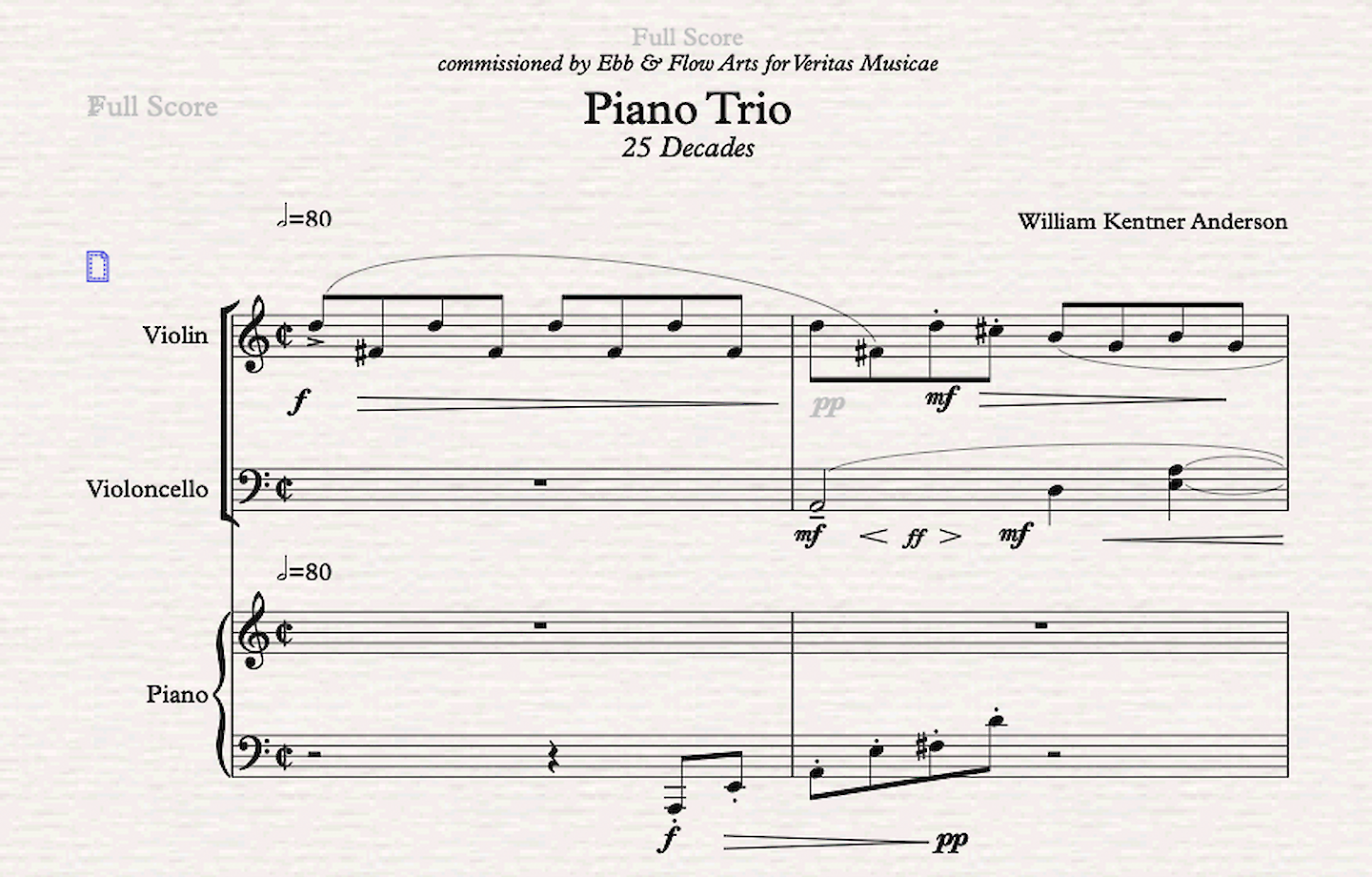
Kentner Anderson's 25 Decades
I'm so grateful to the Horszowski Trio for taking on this piece for
The Village Trip
September 27 7pm
at Greenwich House Music School
46 Barrow Street, New York, NY 10014
tickets:
https://www.thevillagetrip.com/event/25-decades-the-horszowski-trio/
Conversations before music changed drastically in and arund 1918 are intresting again. And I was alwyas curious about that conversation out of respect for our dear, beloved German composers. We have great composers in the US and conversation here is interesting, vital, not to be missed or ignored.
And the pre-1918 convsersation is also very important and a bit lost, eclipsed. the conversation is not generally known or investivated.
This piece is a scherzo. Its sense of humor is more like Schumann's than Brahms. They both loved Jean Paul Richter who had a very particular sense of wit, his own definition of wit -- relating things, marrying things that seem to be far apart.
Wit is the faculty that discovers likeness between remote or dissimilar things — Jean Paul's own image is of wit as "the disguised priest who marries every couple," joining objects nobody expected to see paired. It sits opposite Scharfsinn(acumen), the faculty that finds difference rather than likeness — the two form a matched pair in his system, not a hierarchy.
Another Jean Paul principle is the inverted sublime -- what might inflate others (Kant's sublime), Jean Paul keeps in hand through *applied finitude*, leading to a celebration of the small, the every day things that matter.
Inverted sublime is Jean Paul's term for the mechanism of humor, built as a direct mirror of Kant's sublime. Where the sublime works by confronting an overwhelming infinite — a storm, a starry sky — and finding the mind's reason equal to it, the inverted sublime confronts an overwhelming finite triviality and finds it, held up against the infinite, comically small. Same structure, opposite direction: the sublime elevates by scaling up to the infinite; the inverted sublime deflates by measuring something petty against that same infinite and letting the disproportion do the work. Humor, on this account, is the sublime's mirror image, not its opposite.
Do we see this in Melville's cetological lists in Moby Dick?
The ending, with Gillian Welch's cowboy song, "My Morphine" feels close enough to the ending of the Marx Brothers' Animal Crackers, which ends with a deus ex machina with bug spray. In answer to a the tight spot they got themselves into, they're all knocking themselves out with bug spray. Harpo is the last one up and he grabs a girl and sprays them both.
Now, the Cowboy song ending was the instigation of my piano trio. The opening 5 minutes needed to be fast paced, joyous and tinged with Schumann/Richter/Marx Brothers wit. The piece needed something to lament. And it was necessary to build a town and a society and those had to work, not without friction, but with a sense that all are *dancing around their differences*. That's where Brahms comes in. He also loved Richter, but he did not have Schumann's irony. What I have discovered in Brahms through all this experience is that he did appreciate Jean Paul Richter's celebration of the small. Yes, Brahms makes very big things, but I see them getting small -- First piano concerto, 2nd theme and the transition into it, like water pouring into a small bowl of the Burgherlich, fire-side 2nd theme.
The US had a cult of the small. it's been lost. Jean Paul's is a humorous small, Adalbert Stifter's is not ironic, more like Brahms, and in the US -- Emerson, Whitman, William James, Dewey, they created a cult of the small that did not last longe enough. Some feel it as our core identity, our early blossoming American strength.
William James --> his student Gerturde Stein -- > and her influence upon Parisian modernism
William James' small is at the heart of 20th C, but we've lost the small.
And I am an instructive case -- I never really *felt* Karl Kraus until now.
Brahms, Schumann, Stifter and Jean Paul lived through Napoleon, giving them a distaste for grandiosity. Karl Kraus was responding to the pomposity of the late Austro-Hungarian Empire, which relied on grandeur to keep the populace in thrall.
Only recently did I really feel the need for something like Karl Kraus' acerbic tone.
"In these great times, which I have known when they were this small; which shall become so again, if they are given time enough for it; [...] in these loud times, which groan under the horrendous symphony of deeds which bring forth reports, and of reports which are to blame for deeds: you cannot expect from me any word of my own."
And as the piece was writing itself, with my help, what was going on around me started to creep into it. Program music would work the other way around. This is not really program music. But I realized that the piece bears on Declaration of Independence 250th anniversary. For 25 decades we've been dancing around our differences.
The last major development in the piece is measure 100, where the cowboy song is foreshadowed and it feels like a rupture, and I'm happy about that. The trick was bringing it back, and the piano solo keeps B and G# going until it's wedded to the [GAB] trichord in m. 105, that pulls the exposition back into its world.
The musical concept there is that the harmonic elements must be held tightly, and if there can be a rupture like 100, the feeling of a rupture reassures me that the elements had been holding.
That's very classical. I worked with modernists who were classical in many ways, romantic (which can lead to centrifugal forces) in other ways. Like Brahms, I want to pull things together, keep the center holding.
My musical project and my hopes for America are very similar. And my feeling is that Brahms' op 15 2nd theme is his Bürgerlich version of the same thing.
The links in the chain to the Marx Brothers --
The real chain: Busch's Max und Moritz directly inspired Rudolph Dirks's Katzenjammer Kids (1897) — a documented line, not inferred. That strip was everywhere in American newspapers exactly when the Marx Brothers were coming up through vaudeville, making it a genuine channel for German comic mischief-and-comeuppance to enter the culture they grew up in.
So: Jean Paul and Busch likely share a German root (Grimmelshausen) rather than a direct line; Busch demonstrably begets Katzenjammer Kids; that strip is part of the water the Marx Brothers swam in. Not "Jean Paul reached Groucho" — more that a broader German comic technique, which Jean Paul theorized most explicitly, was in the air both Busch and American newspaper comics breathed. The picaresque is demonstrably in the Marx Brothers; Jean Paul specifically is the harder, unproven claim, but Jean Paul gets into that water.
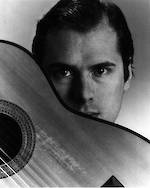
William Anderson
I compose, play plucked instruments, run ensembles, produce concerts, and advocate for new music, I soaked up contemporary American music for 30 years, working directly with composers from all over the map. In the last 20 years I began composing works that draw on that experience, with a particular concern for finding a coherent way to make reconciling musics that were sealed off from one another. How to make embarrassingly simple and charming music work with the most complex musical modalities? Tipping in this direction has made me aware of the dangers of grasping too firmly onto any one notion.
I've come to Macherey's vision that our shadow (what we're *not*) is radiantly present in our work. So it's perfectly reasonable to *love everything*. We're imbricated. --
**The true necessity of the text manifests itself in the fact that not a word of it can be changed and nothing can be added, even though it appears at each moment as though a new topic could be chosen, an alternative narrative selected. But it is precisely this ceaseless shadowy presence of other possible phrases which could be pronounced, this ineradicable sense that things could have been other than they are, which enforces the constraining necessity of the text we actually have before us.**--Macherey